Eight days after American marine biologist Dr. Kent Carpenter was fatally shot inside his home in Sibulan, Negros Oriental, the province’s congressional representative moved to enshrine his legacy in the official record of the Philippine House of Representatives.
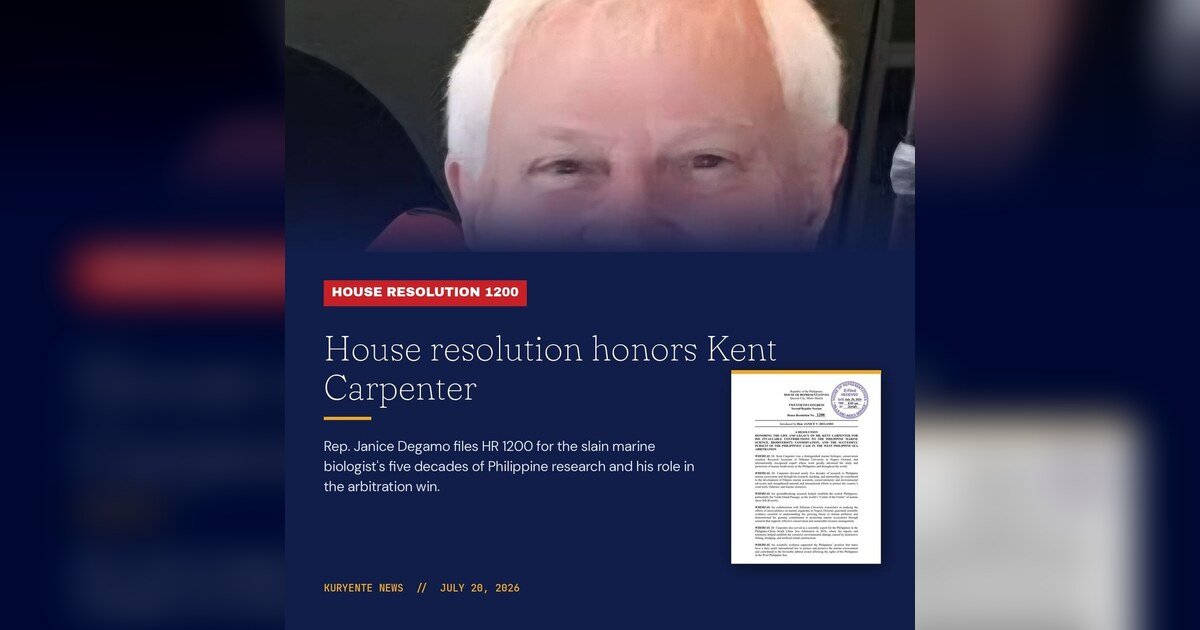
Negros Oriental 3rd District Representative Janice V. Degamo filed House Resolution No. 1200 on Monday, July 20, electronically submitting the measure to the House Bills and Index Service, which received it at 8:05 a.m. under the Twentieth Congress, Second Regular Session, according to official House records.
What the Resolution Formally Recognises
According to the text of the filed measure, the resolution honours Carpenter as a distinguished marine biologist, conservation scientist, and Silliman University research associate who dedicated close to five decades of his professional life to the study of Philippine marine ecosystems.
The measure seeks to place on formal legislative record Carpenter’s wide-ranging contributions to Philippine marine science and biodiversity conservation. It also specifically acknowledges his role in the country’s successful arbitration case against China over the West Philippine Sea — a distinction that sets this resolution apart from a standard memorial tribute.
The resolution credits Carpenter’s research with helping establish the central Philippines — and the Verde Island Passage in particular — as the world’s so-called “Center of the Center” of marine shore fish diversity. The measure likewise recognises his collaborative work with Silliman University researchers examining the effects of microplastics on marine organisms in the province.
His Pivotal Role in the 2016 South China Sea Arbitration
One of the most significant aspects of Carpenter’s legacy recognised in the resolution is his service as a scientific expert for the Philippines during the landmark 2016 South China Sea Arbitration. His expert reports and testimony, according to the resolution, helped document the environmental destruction wrought by destructive fishing practices, dredging operations, and artificial island construction in the disputed waters.
That body of evidence supported the Philippine legal argument that states bear an obligation under international law to protect and preserve the marine environment — a position the arbitral tribunal ultimately upheld in its ruling in favour of the Philippines.
In a statement accompanying the filing, Representative Degamo said Carpenter’s expertise “not only advanced conservation but also helped defend our country’s sovereign rights before the international community.” She described his death as a profound loss to Negros Oriental, to the broader scientific community, and to the Philippine nation.
The Fatal Attack in Sibulan on July 12
Carpenter, who was 73 years old, was shot in the head inside his Sibulan residence on the night of Sunday, July 12, when three masked men forced their way into the home. The Philippine National Police reported that the intruders made off with a laptop computer, cash, and a backpack before fleeing the scene.
A woman present in the residence at the time sustained injuries and was brought for medical treatment. Authorities have confirmed she was also subjected to an additional criminal offense during the intrusion.
The PNP has since announced the arrest of the alleged gunman and several other suspects. Among those taken into custody was a man who had allegedly served as a lookout and later surrendered to authorities. Police also disclosed that one of the arrested individuals had previously been contracted by Carpenter to perform carpentry work at the house. Investigators have continued to pursue a robbery motive while working to establish the full circumstances surrounding the killing, the PNP said.
A Career Spanning Nearly Five Decades
Carpenter was a professor of biological sciences at Old Dominion University in Norfolk, Virginia, and held the position of manager for the IUCN Global Marine Species Assessment, one of the most comprehensive databases of marine species conservation status in the world.
His connection to the Philippines stretched back to the 1970s, when he first began studying Philippine marine fishes. In 2005, he co-authored the landmark study that formally identified the Verde Island Passage as the global epicentre of marine shore fish biodiversity — a finding with profound implications for conservation policy in the region.
At the time of his death, Carpenter was in the Philippines on an extended research assignment. Old Dominion University confirmed that he had been planning to retire in September, according to university records.
His passing prompted an outpouring of grief from Filipino scientists, conservation organisations, and marine protected area managers throughout the country, underscoring the depth of his integration into the Philippine scientific community over the course of his career.
Resolution to Reach Family and Partner Institutions
Beyond formal recognition, the resolution calls on the House of Representatives to express the nation’s gratitude for Carpenter’s contributions to Philippine science and sovereignty, and to extend its official condolences to his family, academic colleagues, students, and the wider marine science community.
As stipulated in the text of the measure filed by Representative Degamo, copies of the resolution are to be transmitted to Carpenter’s family and to the institutions he served throughout his distinguished career.
By the Numbers
- House Resolution No. 1200 — the resolution filed by Rep. Degamo under the Twentieth Congress, Second Regular Session
- 8:05 a.m., July 20 — the time the resolution was received by the House Bills and Index Service
- 73 — Dr. Carpenter’s age at the time of his death
- July 12 — the date of the fatal shooting at his Sibulan residence
- Nearly five decades — the span of Carpenter’s research on Philippine marine ecosystems
- 2005 — year the co-authored study named the Verde Island Passage as the global centre of marine shore fish biodiversity
- 2016 — year of the South China Sea Arbitration in which Carpenter served as a scientific expert for the Philippines
Why This Matters
Dr. Kent Carpenter’s scientific record directly shaped the Philippines’ successful arbitration case against China in 2016, providing evidence of environmental destruction in contested waters that supported a ruling with enduring significance for Philippine sovereign rights over the West Philippine Sea.
The filing of House Resolution No. 1200 represents a formal legislative acknowledgment that a foreign researcher’s decades of work in the Philippines carried consequences far beyond academia — touching national security, international law, and environmental policy simultaneously.
The active PNP investigation, which has already resulted in multiple arrests, remains under close national scrutiny as authorities work to fully establish the motive behind the killing of a scientist who had become one of the most consequential voices in Philippine marine conservation.
Source: breakingnewsnegrosoriental.com